
Monday, October 31, 2011

Statistics Quiz
If you randomly choose an answer to this question from the options provided, what is the chance that you'll choose the correct answer?
A) 25%
B) 50%
C) 0%
D) 25%
(H/T Shamus Young)
A) 25%
B) 50%
C) 0%
D) 25%
(H/T Shamus Young)
Sunday, October 30, 2011


Friday, October 28, 2011
Science Discovers Cure for Too Many Brain Cells
I'll just go ahead and leave this here.
Special guest brain cell killing by Barats and Bereta.
Special guest brain cell killing by Barats and Bereta.
Wednesday, October 26, 2011
The Damien-English Dictionary
The complete vocabulary
- Mama – Mommy (also used to identify an iPhone)
- Dada – Daddy/Donald
- Dadeye – Strawberry
- Nana – Banana
- Appo – Apple
- Ba-ba – Bottle
- Deedy – Mickey/Teddy
- Neeny/Ninny – Minnie
- Bubo – Pluto
- Doody – Goofy
- Daisy – Daisy Duck
- Pete – Pete the Cat
- Ohtoo – Toodles (Oh Toodles!)
- Adda/Addeye – Anthony
- Beeby – Baby (used interchangeably with Anthony for any baby/doll-like object)
- C-A-T Cat – Cat
- Mow/Mowf – Mouse
- Esseh – Elephant
- Giwah – Giraffe
- Bee – Bear
- Meow, Woof, Moo, Baa-a-a, Neigh, Oink, Qua (quack), Do-do-dooo (Cocka-doodle-doo), Twee (tweet, squeak), Roar, Gwah (growl), Ribbit, Hoot, Oo-ah-ah (howler monkey) – Various animal noises
- Ohwy – (Oh Really?) Snowy Owl sound
- Yahwy – (Ya Really!) Horned Owl sound
- Dadum, dadum, dadum, dadum – Shark noises
- Voom voom – Car sound effect
- Choo choo – Train sound effect
- Dwuh – Truck (no F-bombs from our little one)
- Uh-oh, Oh no! – Various exclamations (usually said with hands on side of head or on cheeks)
- Night-night! – Goodnight
- Hi – Hello
- Bye – Goodbye
- Aww – What he says when leaning in for a hug
- Yay! (clapping) – Used after a song
- Wuh, Two, Twee, Fo, Fi, Si, Sehseh, Ay, Ni, Ten, Lehveh, Twev, Tootee, Fotee, Fitee, Sitee, Sehtee, Aytee, Nitee, Twehtee! – Numbers
- Weh, Ownh (nasally grunt at the end), Yewo, Gwee, Boo, Popo, Bwa, Why – Colors
- Whasa? – What's that?
- Hussssssssss – The old woman whispering "hush"
- Up, UP, UP! – Where the Snort takes the Baby Bird
- Boo (short oo) – Book
- Boo! (long oo) – Boo!
- Deedoo! – Peekaboo!
- Yoda, Ahtoo – Star Wars characters
- Bah – Ball
- Bwah – Block
- Soosoo – Circle
- Suhsuhsuh – Cylinder
- Cue – Cube
- Twiah – Triangle
- Eye, No, Mouf, Ee (ear), Heh (head/hair), Chee (cheek), Teef, Knee, Foo, Toe – Body parts
- Fafa, suh, *kiss* – The Sign of the Cross, kissing the Rosary at the end
Further bulletins as events warrant.
Tuesday, October 25, 2011
QFT
"If you're going to come here and get our food, bedding and clothing, have books and medical supplies for no charge, they need to give back. There's a lot of takers here and they feel entitled." [Emphasis added.]
--Lauren Digioia, member of the OWS Sanitation Comittee, on the vagrants in Zuccotti Park, quoted in the NY Daily News.
(H/T Mike Flynn)
Sunday, October 23, 2011
The Art of Non-Argument: How to Debate without Debating
There is a strand of argumentation that I have been seeing very frequently of late, and it is one of which I have become increasingly weary, and would love nothing more than if the entire world just agreed to drop the whole thing for the good of mankind. Rightly speaking, it isn't really even an argument, but rather a non-argument. It is an attempt to do away with argument, stop it cold in its tracks, so that the conversation can't continue.
This non-argument is seen in many different conversations and is stated in many different ways. It comes up in conversations about law, about justice, and about public morality. Its specifics vary from time to time, but it almost always starts with the following statement: "that may be your personal opinion, but...."
In effect this non-argument does not insist that the opposing view is wrong, but rather that the opposing view is irrelevant. It doesn't matter how reasonable, how rational, or how true the opposing view is. All that matters is that the opposing view has no place interfering with the outside world. It is not an attempt to refute the view, or show where the one proposing it has erred. It is a trump card, designed not to engage in debate, but rather to avoid debate altogether. Playing this trump card is simply an attempt to prevent the logic and reason of others from having influence on one's own thought.
And I can easily see why one might be tempted to make this non-argument. As we have seen from the ladder of inference, the premises we take to a conversation—true or false—are personal and based on our experiences. Another person, with another set of experiences, may approach the conversation with a different premise. Since no amount of rational argument or reasonable deduction will convince another person that his experiences did not happen, it is in most cases impossible to change the opinion of the other person. And since the premises—and experiences upon which they are based—are not only not the topic of the conversation, but most frequently are not even brought up, we most often don't even know why we disagree on the topic. The rude person assumes the other person has a defective brain, and calls him stupid or his views irrational. The charitable person, trying to understand how a seemingly intelligent and reasonable person may have arrived at such an unintelligent and unreasonable conclusion, may be tempted to simply invoke the non-argument. That is, "well, the person may have reasons for his belief, but since they are not my reasons, they don't affect me." Hence, the "that may be your personal belief...."
What irks me most about the non-argument, is that, in its attempt to defuse the disagreement charitably, it doesn't seem to have thought itself through very well. For, truly, aren't all our beliefs personal? If one person's argument is not admissible because it's his personal belief, why not any other's? Shouldn't we adopt the post permissible moral code possible? "Well, yes," reply the non-arguers. "To each his own." But then, does that not allow for all sorts of atrocities, from murder, rape, and torture to shoplifting, petty theft and everything in between? "No of course not! You mustn't harm another person!" But... isn't this your personal belief? And since the definition of "person" is one of the very things the non-argument is often used to obfuscate, why should we use your personal definition of personhood over any other? Taking it further, isn't it only your personal belief that personal beliefs should not be forced on others? In its attempt to marginalize the other person's argument, the non-argument marginalizes itself.
The non-argument attempts to reduce law, justice, and morality to the realm of the subjective, such that preference for one morality over another is simply like a preference for chocolate over vanilla. The problem is, I've never met someone who actually treats morality as if its not objective. Those who make the assertion that morality is always a private matter are the ones who are most indignant and most self-righteous at perceived injustices against themselves or others. If all morality is a private matter, subject to personal opinion, then there can be nothing inherently immoral about injustice. On what ground do you protest someone who commits an injustice against another? It may be your personal opinion that his actions are immoral, but who are you to enforce your personal opinions on others?
Of course, I'm being a little unfair here by grouping everyone who makes the non-argument into a group with those who deny objective morality. Many who non-argue are not opposed to the concept of a universal moral law, but rather, simply misunderstand the opposing view. The non-arguer may not understand the reasons behind his opponent's views, and just simply infer that it's for some mysterious unknowable reason. "You only say that because you think the Bible tells you to." But this, again, is a non-argument, because it doesn't address the actual reasons behind the view, just the inferred reasons. It ignores the appeals to natural law and objective truth, and instead simply attacks a strawman.
Despite these obvious (to me) problems with the non-argument, I continue to see it used whenever someone doesn't want to admit a view contrary to their own into the debate. Whenever someone takes a stand for traditional marriage, the non-argument will be made "that's just your personal opinion about marriage! You can't force that on others!" Whenever someone says that it is an injustice to deny the unborn their rights, someone else will non-argue "but that's merely your opinion on personhood! You can't deny a woman her right to choose!" Whenever someone explains the moral difficulties of euthanasia, the non-argument appears, "keep your morality off my body!" In none of the cases is the non-arguer actually making a case about the nature of marriage, the rights of the human person, or the dignity of human life. All he is saying is that all such arguments are irrelevant.
What irks me most about the non-argument, is that, in its attempt to defuse the disagreement charitably, it doesn't seem to have thought itself through very well. For, truly, aren't all our beliefs personal? If one person's argument is not admissible because it's his personal belief, why not any other's? Shouldn't we adopt the post permissible moral code possible? "Well, yes," reply the non-arguers. "To each his own." But then, does that not allow for all sorts of atrocities, from murder, rape, and torture to shoplifting, petty theft and everything in between? "No of course not! You mustn't harm another person!" But... isn't this your personal belief? And since the definition of "person" is one of the very things the non-argument is often used to obfuscate, why should we use your personal definition of personhood over any other? Taking it further, isn't it only your personal belief that personal beliefs should not be forced on others? In its attempt to marginalize the other person's argument, the non-argument marginalizes itself.
The non-argument attempts to reduce law, justice, and morality to the realm of the subjective, such that preference for one morality over another is simply like a preference for chocolate over vanilla. The problem is, I've never met someone who actually treats morality as if its not objective. Those who make the assertion that morality is always a private matter are the ones who are most indignant and most self-righteous at perceived injustices against themselves or others. If all morality is a private matter, subject to personal opinion, then there can be nothing inherently immoral about injustice. On what ground do you protest someone who commits an injustice against another? It may be your personal opinion that his actions are immoral, but who are you to enforce your personal opinions on others?
Of course, I'm being a little unfair here by grouping everyone who makes the non-argument into a group with those who deny objective morality. Many who non-argue are not opposed to the concept of a universal moral law, but rather, simply misunderstand the opposing view. The non-arguer may not understand the reasons behind his opponent's views, and just simply infer that it's for some mysterious unknowable reason. "You only say that because you think the Bible tells you to." But this, again, is a non-argument, because it doesn't address the actual reasons behind the view, just the inferred reasons. It ignores the appeals to natural law and objective truth, and instead simply attacks a strawman.
Despite these obvious (to me) problems with the non-argument, I continue to see it used whenever someone doesn't want to admit a view contrary to their own into the debate. Whenever someone takes a stand for traditional marriage, the non-argument will be made "that's just your personal opinion about marriage! You can't force that on others!" Whenever someone says that it is an injustice to deny the unborn their rights, someone else will non-argue "but that's merely your opinion on personhood! You can't deny a woman her right to choose!" Whenever someone explains the moral difficulties of euthanasia, the non-argument appears, "keep your morality off my body!" In none of the cases is the non-arguer actually making a case about the nature of marriage, the rights of the human person, or the dignity of human life. All he is saying is that all such arguments are irrelevant.
Saturday, October 22, 2011
World of Warcraft: Attack of the Pandas
Following on the heels of their success with 2004's hit World of Warcraft, Blizzard Entertainment upped the stakes. For their 2007 expansion The Burning Crusade, they introduced the corrupted demon-hunter Illidan Stormrage, Lord of the Black Temple.
To up the ante even further, for 2008's Wrath of the Lich King, the brought out the Lich King, Arthas, ruler of the Scourge: a race of undead monstrosities, who terrorize the people of Azeroth.
And building upon that, 2010's Cataclysm introduced Deathwing to the world, a dragon aspect consumed with hatred for all that lives, and whose explosive release unleashed a wave of destructive force across all the world.
So what can Blizzard possibly introduce to top this incredible lineup of menacing villains? What is the next horror the denizens of Azeroth face?
Giant Pandas!
 |
| You are not prepared! |
 |
| His frozen heart lies beneath the tundra of Northrend. |
 |
| The world shall burn. |
Giant Pandas!
 |
| Their superpower is the Power of Love. |
Thursday, October 20, 2011
Hateful Kitty
Kathleen De Vere, of my favorite Commodore 64-based Canadian sketch comedy group "Loading Ready Run", has seen fit to draw an entry to her webcomic "Things My Cat Hates" based on a suggestion I sent her.
You should go check it out by clicking here.
Or here.
Or here, if you like to wait until the last minute, but that will be your last chance.
Of course, Kathleen, herself, had one of her tweets used in an Old Spice internet response ad last year. For those keeping track, this gives me an Old Spice Man Your Man Could Smell Like index of two.
(OK, I lied. This is really your last chance. For reals.)
You should go check it out by clicking here.
Or here.
Or here, if you like to wait until the last minute, but that will be your last chance.
Of course, Kathleen, herself, had one of her tweets used in an Old Spice internet response ad last year. For those keeping track, this gives me an Old Spice Man Your Man Could Smell Like index of two.
(OK, I lied. This is really your last chance. For reals.)
Friday, October 14, 2011
Premises, Premises
So, I've had the idea for this post for a while, but haven't been able to put it in words. I had planned writing a long, rambling, boring post, but I realized it could probably be said better shorter.
Also, it helps that SF author, statistician, amateur philosopher and historian, and all around Cool Guy Michael Flynn has done the bulk of the work for me. Recently, he wrote a piece on the "ladder of inference". You should go read it. No, seriously. Go. I'll wait.
All done? To summarize for those too lazy to read, the ladder of inference is basically the process we mentally apply whenever presented with facts. It goes like this:
Also, it helps that SF author, statistician, amateur philosopher and historian, and all around Cool Guy Michael Flynn has done the bulk of the work for me. Recently, he wrote a piece on the "ladder of inference". You should go read it. No, seriously. Go. I'll wait.
All done? To summarize for those too lazy to read, the ladder of inference is basically the process we mentally apply whenever presented with facts. It goes like this:
- I observe objectively.
- I select data from what I observer.
- I add meaning to what I have selected.
- I make assumptions based on the meaning I have added.
- I draw conclusions, which prompt feelings.
- I adopt beliefs about the world.
- I take action based on my beliefs and feelings.
Now, there is a loop, called the Reflexive Loop from step 6 to step 2: our beliefs influence what data we select from our observations. This is why two people can be presented with the same set of data and draw completely different conclusions about it. Based on their beliefs, developed from previous experiences, people will notice different things, infer different meanings, and make different assumptions from the same things.
For our purposes, I will refer to these beliefs that influence our observations and actions as "premises". These are not, of course, philosophical premises in the sense of "first principles", since they are based on prior experiences. But, for a given situation, they are the things we assume are a given, and not topics for discussion.
Now, the problem is people tend to assume that their experiences are universal, and internalize their premises to such a point that they assume everyone else shares them. So when two people observe the same data, and come to different conclusions, if they've climbed too high, too fast, on the ladder of inference, they'll be completely at a loss to understand how the other person came to another conclusion.
This is why arguing on the internet is, for the most part, completely futile. Every time you see two people going at it in comboxes, each one talking past the other, it's typically because one (or both) have climbed too high on the ladder. Each one assumes his premises to be true, based on experiences he assumes are universal. And since the premises are usually not the things being discussed, the "conversation" continues apace, with neither party actually hearing or addressing the points made by the other.
Every time you come across a pro-life person lamenting how much pro-choice people hate babies, while the pro-choice person bemoans that pro-lifers hate women, it's because of the ladder. When you see a same-sex marriage advocate calling a traditional marriage advocate a homophobe, while the latter insists that God intended marriage to be between a man and a woman and why-oh-why can't the homosexuals understand this, it's the ladder. And when you see an atheist call all religion irrational while the theist is calling atheists blind, it's the ladder. None of the parties are acknowledging that the other person may have a different starting point for his beliefs because of his different life experiences.
(Note: I'm not saying that neither person is correct, or that both views are true; I'm just saying that someone's reasons for holding a belief are, in the vast majority of circumstances, rational and well-intentioned, no matter how wrong it might be.)
So it's a particularly treasured moment when someone reveals in plain language, right off the gate, what his premises are. It allows one to see why, exactly, that person holds the beliefs that he holds,
This is all a very, very roundabout way of introducing the topic of a document released by the International Planned Parenthood Federation called "Exclaim!: Young People's Guide to 'Sexual Rights'". An old college buddy of mine linked to it on the blog of his psychotherapy practice as an example of the "philosophy and social conditioning that the youth of today experience in our culture."
I found it fascinating because it puts the premises of the the sexually promiscuous culture right out front, plain to see. For instance:
 |
| Other newly-discovered rights: the pleasure of eating irrespective of desires for nourishment; the right to breathe without respiration; and the freedom to jump off cliffs without falling. |
Simply put, it is a premise of the culture of death that everyone has a right to sex without babies. From here, it is easy to see how you end up with the right to abortion. If you have a right to actions without consequences, when the consequences occur, they are interfering with your rights. It's also easy to see why they think that pro-lifers are "denying a woman her rights".
This is important, because any pro-life argument that fails to address this mentality is doomed to failure. Any argument that starts with the humanity of the unborn is a futile argument. What a fetus is does not matter to a woman's right to "sexual freedom". If stealing candy from African AIDS orphans was necessary for sexual freedom, that would be justified by this premise.
This explains the cognitive dissonance exhibited in other places in the document. For instance, on page 8, IPPF defines all human rights, as universal, inalienable, indivisible, interrelated and interdependent, and impose obligations, then goes on to define inalienable:
INALIENABLE: Everyone is entitled to human rights simply for being human [NB: "for being human". Not "person". This undercuts the "the fetus isn't a person" objection]. Human rights cannot be taken away or given up from anyone, irrespective of their age [So... a 10-week gestational human being cannot have its rights taken away?], gender, ethnicity, race, religion, nationality, sexual orientation, socio-economic status, disability, HIV status or health status.Then, on page 19, while listing human rights, they state:
"Everyone has the right to life, liberty, and to be free from harm."There are, of course, implications to these two statements. But the ladder of inference can prevent someone from seeing them.
Thursday, October 13, 2011

Wednesday, October 12, 2011
Is This the Line for the Apple Store?
I don't normally recommend the webcomic Least I Could Do, but when I do, it's freaking hilarious.
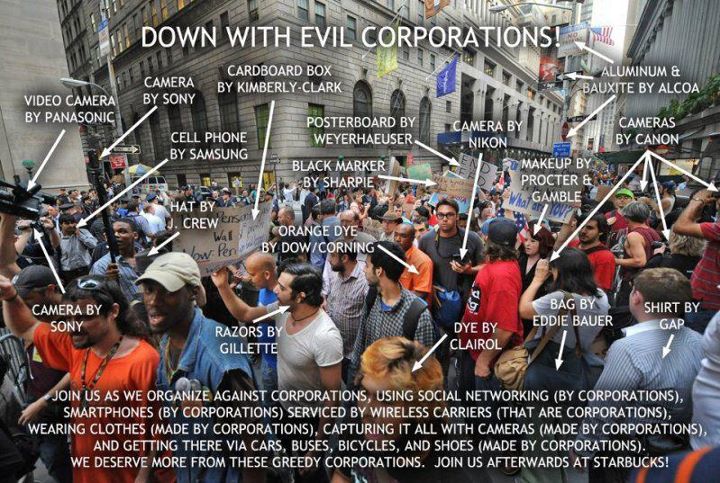
The "Occupy Wall Street" protests bring three things to my mind:


The "Occupy Wall Street" protests bring three things to my mind:
- Why should I care if my neighbor makes a million times more money than I do? Anytime I see some statistic like "the discrepancy between rich and poor is the greatest it's ever been in history" or "the wealthiest 400 Americans have as much money as the poorest 150 million," my reaction is "so?" This is nothing more than a red herring. If the poor have the necessities they need to survive, then it doesn't matter how much money the rich have. If the poor don't have the necessities they need to survive, then it doesn't matter how much money the rich have.
- The anger and rage seems to be aimed at "bankers" and "Wall Street". If the protesters could name names and deeds of people who have committed crimes, they may have a point. But to blame "Wall Street" or "bankers" seems to blame a class, rather than a person. You might as well just blame the Jews.
- "You shall not covet your neighbor’s house. You shall not covet your neighbor’s wife, his male or female slave, his ox or donkey, or anything that belongs to your neighbor." (Ex. 20:17)
Also, this was interesting, for those who haven't seen it:

Chesterton Quote of the Day/Week/Month
For you mothers.
Supposing it to be conceded that humanity has acted at least not unnaturally in dividing itself into two halves, respectively typifying the ideals of special talent and of general sanity (since they are genuinely difficult to combine completely in one mind), it is not difficult to see why the line of cleavage has followed the line of sex, or why the female became the emblem of the universal and the male of the special and superior. Two gigantic facts of nature fixed it thus: first, that the woman who frequently fulfilled her functions literally could not be specially prominent in experiment and adventure; and second, that the same natural operation surrounded her with very young children, who require to be taught not so much anything as everything. Babies need not to be taught a trade, but to be introduced to a world. To put the matter shortly, woman is generally shut up in a house with a human being at the time when he asks all the questions that there are, and some that there aren't. It would be odd if she retained any of the narrowness of a specialist. Now if anyone says that this duty of general enlightenment (even when freed from modern rules and hours, and exercised more spontaneously by a more protected person) is in itself too exacting and oppressive, I can understand the view. I can only answer that our race has thought it worth while to cast this burden on women in order to keep common-sense in the world. But when people begin to talk about this domestic duty as not merely difficult but trivial and dreary, I simply give up the question. For I cannot with the utmost energy of imagination conceive what they mean. When domesticity, for instance, is called drudgery, all the difficulty arises from a double meaning in the word. If drudgery only means dreadfully hard work, I admit the woman drudges in the home, as a man might drudge at the Cathedral of Amiens or drudge behind a gun at Trafalgar. But if it means that the hard work is more heavy because it is trifling, colorless and of small import to the soul, then as I say, I give it up; I do not know what the words mean. To be Queen Elizabeth within a definite area, deciding sales, banquets, labors and holidays; to be Whiteley within a certain area, providing toys, boots, sheets, cakes and books, to be Aristotle within a certain area, teaching morals, manners, theology, and hygiene; I can understand how this might exhaust the mind, but I cannot imagine how it could narrow it. How can it be a large career to tell other people's children about the Rule of Three, and a small career to tell one's own children about the universe? How can it be broad to be the same thing to everyone, and narrow to be everything to someone? No; a woman's function is laborious, but because it is gigantic, not because it is minute. I will pity Mrs. Jones for the hugeness of her task; I will never pity her for its smallness.
--G.K. Chesterton, What's Wrong with he World, Part 3 "Feminism, or the Mistake about Woman", III "The Emancipation of Domesticity".
Supposing it to be conceded that humanity has acted at least not unnaturally in dividing itself into two halves, respectively typifying the ideals of special talent and of general sanity (since they are genuinely difficult to combine completely in one mind), it is not difficult to see why the line of cleavage has followed the line of sex, or why the female became the emblem of the universal and the male of the special and superior. Two gigantic facts of nature fixed it thus: first, that the woman who frequently fulfilled her functions literally could not be specially prominent in experiment and adventure; and second, that the same natural operation surrounded her with very young children, who require to be taught not so much anything as everything. Babies need not to be taught a trade, but to be introduced to a world. To put the matter shortly, woman is generally shut up in a house with a human being at the time when he asks all the questions that there are, and some that there aren't. It would be odd if she retained any of the narrowness of a specialist. Now if anyone says that this duty of general enlightenment (even when freed from modern rules and hours, and exercised more spontaneously by a more protected person) is in itself too exacting and oppressive, I can understand the view. I can only answer that our race has thought it worth while to cast this burden on women in order to keep common-sense in the world. But when people begin to talk about this domestic duty as not merely difficult but trivial and dreary, I simply give up the question. For I cannot with the utmost energy of imagination conceive what they mean. When domesticity, for instance, is called drudgery, all the difficulty arises from a double meaning in the word. If drudgery only means dreadfully hard work, I admit the woman drudges in the home, as a man might drudge at the Cathedral of Amiens or drudge behind a gun at Trafalgar. But if it means that the hard work is more heavy because it is trifling, colorless and of small import to the soul, then as I say, I give it up; I do not know what the words mean. To be Queen Elizabeth within a definite area, deciding sales, banquets, labors and holidays; to be Whiteley within a certain area, providing toys, boots, sheets, cakes and books, to be Aristotle within a certain area, teaching morals, manners, theology, and hygiene; I can understand how this might exhaust the mind, but I cannot imagine how it could narrow it. How can it be a large career to tell other people's children about the Rule of Three, and a small career to tell one's own children about the universe? How can it be broad to be the same thing to everyone, and narrow to be everything to someone? No; a woman's function is laborious, but because it is gigantic, not because it is minute. I will pity Mrs. Jones for the hugeness of her task; I will never pity her for its smallness.
--G.K. Chesterton, What's Wrong with he World, Part 3 "Feminism, or the Mistake about Woman", III "The Emancipation of Domesticity".
Tuesday, October 11, 2011
Some Much Needed Perspective
Ok, let's get something straight. I've seen a risible idea circulating lately and I cannot let it stand, so I have come to set the record straight.
You ready?
Steve Jobs Did Not Change The World.
Blasphemy! I hear you say.
But get over it. He did no such thing.
To prove my point, here's a list of 11 things that Changed the World:
You ready?
Steve Jobs Did Not Change The World.
Blasphemy! I hear you say.
But get over it. He did no such thing.
To prove my point, here's a list of 11 things that Changed the World:
- Christianity
- Islam
- The Roman Empire
- Aristotelian and Thomistic philosophy
- The scientific world view (that material causes can explain empirical observations without invoking supernatural causes, not that everything can be explained scientifically, I mean).
- The Protestant Revolt
- The Enlightenment
- The steam engine
- The industrial revolution
- The automobile
- Electrification
Here are 5 things that have not changed the world, but have made life slightly more convenient for those living in the first world:
- The graphical user interface
- The portable MP3 player
- The online music store
- The smartphone
- The tablet PC
The personal computer probably has changed the world (although since it's less than 50 years old, it's hard to say how much those changes will matter in 1000 years), but Steve Jobs did not invent it. Speaking of which, here is a list of 5 things Steve Jobs did not invent:
- The graphical user interface
- The portable MP3 player
- The online music store
- The smartphone
- The tablet PC
Nope. Nuh-uh. Not a one. What he did is best summarized in this Basic Instructions: Steve Jobs is the kid who copies off your test, then gets a better grade than you.
What Steve Jobs did is shape the development of one world-changing device, and several minor conveniences. All would have developed without him. They might not have developed in the same way. Some ideas may not have been implemented, or taken longer to refine. Maybe the wouldn't have caught on and been as widespread, But they'd still all be there.
If Steve Jobs never existed, you would still own a personal computer. You'd still be reading my writing on your color rasterizationator through the intertubes. E-Commerce would still exist. You could still listen to music you purchased online on your portable MP3 player. You could check email on your phone. You might do it all differently; you might not do any of it at all, but you still could do it all.
Contrast this with Aristotle and Thomas Aquinas. As Mike Flynn points out, without them, there may never have been a scientific revolution. Universities may not have put such an emphasis on natural philosophy. Middle Ages and Renaissance scientists may never have said "what if" and asked how the world worked. Copernicus, Brahe, and Kepler may never have seen a need to update Ptolemy (it worked; why fix it?). No science, no industrial revolution, no modern life. To be sure, those things may have come, but it may have been centuries later. We might be living in the technological equivalent of the 17th century.
Introducing a fundamental change to the way people view the world, whose echoes still shape thought 2000 years later. That's changing the world. Not making a device that allows rich people to listen to music on the go.
Saturday, October 1, 2011
Photodump
Totally Looks Like
Come to think of it, why has no one ever been able to take a picture of both Damien and Anthony at the same time?
On the Occasion of the Resident Toddler's Second Birthday.
According to the Baby Center Height Predictor, this puts him within 2.1" of 6'4" at age eighteen, with 90% confidence.
Chief Engineer Smiles O'Brien, Reporting for Duty.

Polite Babbies Always Drink their Milk with Pinky Fingers Extended.

All I Ask Is a Carrot to Ride and a Cake Wreck to Steer Her By.
 |
| Anthony totally looks like Perry the Platypus. |
 |  |
| Damien totally looks like Anthony | |
 |  |
| Therefore, Damien totally looks like Perry the Platypus | |
Come to think of it, why has no one ever been able to take a picture of both Damien and Anthony at the same time?
 |
| There we go. |
 |
| This is inaccurate. Two weeks later, the pediatrician measured him at 37". |
Chief Engineer Smiles O'Brien, Reporting for Duty.

Polite Babbies Always Drink their Milk with Pinky Fingers Extended.

All I Ask Is a Carrot to Ride and a Cake Wreck to Steer Her By.
 |
| A reference to the infamous "Carrot Jockey" cake wreck. |
Subscribe to:
Posts (Atom)